
TL;DR – A Dub Box is a hardware multi-effects unit (delay, spring reverb, filters, siren) designed to be played live, in the pure tradition of King Tubby’s Jamaican studios. It plugs into a console’s aux sends and transforms a static mix into an organic performance.
To compare series wiring with an auxiliary loop, the guide to connecting an effect to a mixer shows the connections.
What is a Dub Box?
A Dub Box is a compact analogue or digital effects processor designed specifically for real-time audio manipulation, emblematic of Dub music and Sound System culture. It combines all the essential tools of the genre in a single box: a delay (echo), a reverb (often spring-loaded), high-pass and low-pass filters, and frequently an integrated Dub Siren.
His aim? To transform a static mix into a lively, dub-wise, organic performance. Connected to the auxiliary sends of a mixing console, it allows the selector or sound engineer to play the effects like an instrument, in the tradition of the Jamaican studios of King Tubby, Lee “Scratch” Perry or Scientist.
Anatomy of a Dub Box: key features
Delay (Echo): the heart of the device
The delay is the central element of any self-respecting Dub Box. It creates the cascading repetitions that are so characteristic of Dub. Three parameters are essential:
- Time (Rate) – length of time between repeats, often synchronised with the tempo
- Feedback – number of repetitions, creating self-oscillating infinite loops typical of the King Tubby style.
- Mix (Wet/Dry ) – dosing of the processed signal
Feedback pushed to the limit of self-oscillation is the signature sound of Dub. It’s that moment when the echo takes on a life of its own and ‘explodes’ in the mix.
See also our article on The best dub effects!
Spring Reverb
Often associated with delay, spring reverb adds that characteristic splashy metallic resonance. Top-of-the-range models feature a real spring tank – sometimes even physically shakable to produce the mythical thunderous crash of Jamaican sound systems.
The Dub Siren
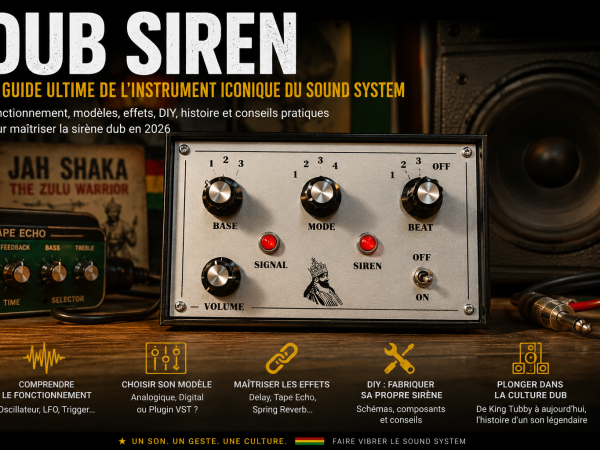
A true cultural signature, the Dub Siren is an integrated oscillator that generates sirens, rising frequencies and punchy sounds. Modulated through delay and reverb, it becomes the selecta’s ultimate weapon for kick-starting a set or marking a transition.
Equalisation and filtering
Robust potentiometers(HPF / LPF) cut bass or isolate high frequencies live. This is what creates those famous drops where the music seems to disappear before returning en masse.
Connectors
6.35 mm jack inputs and outputs, often unbalanced to preserve the vintage feel. Boutique models sometimes offer XLR or dedicated inserts to integrate with any analogue console.
See also our article on how a sound system works.

Dub Box vs VST plugin: why hardware is still king
In the digital age, one might ask why invest in a physical device when dozens of plugins emulate these effects. The answer can be summed up in three words: touch, latency and character.
A Dub Box is played like an instrument. Turning a feedback pot live, feeling the resistance of a component, adjusting a filter with your fingertips while a track is playing: these gestures are impossible to reproduce with a mouse.
The zero latency of analogue circuits allows instant reaction, which is essential for live performance. Above all, it’s the imperfections of analogue – the slight saturation of the preamp, the warmth of the transistors, the micro-drift of the oscillator – that create the warmth sought after by Reggae and Dub producers.
A plug-in reproduces the signal. A Dub Box reproduces the gesture and the accident.
Buying guide: the best Dub Boxes on the market
| Model | Type | Guide price | Who is it for? | Highlights |
|---|---|---|---|---|
| Klementz Dub Mixer | Dub box / modern mini preamp | 549 € | Best overall choice | Stereo, compact, built-in effects, customisable FX sends, variable crossover, excellent value for money |
| Dub-Sonic Dubbox | Traditional dub mini-preamp | 600 € | Sound systems, selectors roots | Integrated NJD siren, integrated echo/delay, microphone input, music input, 3-way active filter |
| Benidub FX-ONE | Top-of-the-range live dub box | 1 199 € | Live performers, studios, demanding sound systems | 4 effects generators, mic, aux, central echo, comprehensive live control |
| Benidub DS01E | Siren + built-in echo | 430 € | Those who want a mermaid ready to mix | Old school DS01 sound, integrated delay, HP/LP filters, compact size |
| Benidub Digital Echo | Delay / echo dub | 400 € | Studio, live dub, dub mix | FV-1 DSP, analogue HP/LP filters, saturation, musical feedback |
| Benidub Spring Amp III | Spring reverb dub | 430 € | Lovers of real spring reverb | Spring reverb preamp, LP/HP filter, smooth saturation, classic dub sound |
| Ras EFX / Dub-Siren.com | Sirens and craft combos | Variable | Budget custom / DIY spirit | Many formats, sirens, delay/reverb, customisation |
| Korg Monotron Delay | Low-cost mini synth / delay | 50-80 € | Beginners, lo-fi effects | Cheap, fun, dirty delay, MS-20 filter |
| DIY kits | Modules to assemble | 100-300 € | DIY enthusiasts, electronic enthusiasts | Customisable, economical, educational |
How to integrate a Dub Box into your audio system
The classic way to use an effect is via the Aux Sends on a console:
- The dry signal (vocals, bass, drums) is routed to the Dub Box via an Aux Send.
- The Dub Box processes the signal – delay, reverb, filtering, siren, etc.
- The processed return signal returns to the console via an Aux Return or a free channel.
- The selecta doses the dry/wet mix in real time during the set
Advanced tip: for more control, it’s best to use the dub box as a classic mixer: input your sources on it and output directly to your amps;
Like a preamp !
Glossary: the Dub lexicon
- Feedback – feedback from the delay output to its input, creating multiple repetitions
- Rate – speed or frequency of an oscillator or LFO
- Depth – modulation depth of an effect (chorus, vibrato, phaser)
- Send / Return – circuit for sending and returning an effect via a console
- Rub-a-dub – instrumental mixing style derived from Reggae, popularised in Jamaica in the 70s.
- Preamp – input preamplifier, which colours the signal before processing
- Saturation – gentle harmonic distortion, adding character and warmth
FAQ – Everything you need to know about the Dub Box
Can a Dub Box be used for styles other than Reggae?
Absolutely. While the Dub Box originated in Jamaican Reggae, it is now widely used in Techno, Dub Techno (Berlin school), Ambient, experimental Hip-hop and Bass Music. Basic Channel, Pole, Andy Stott and Shackleton have all built part of their sound identity around these effects.
What’s the difference between a classic delay and a Dub Box?
A classic delay offers a single effect: echo. A Dub Box is a multi-effect dedicated to live performance, combining delay, reverb, filters and often a siren, in an ergonomic design designed to be manipulated in real time. It’s the difference between a tool and a live instrument.
Do I need an analogue or digital Dub Box?
Analogue models offer inimitable organic grain and highly musical self-oscillation, but cost more. Digital or hybrid models offer more functions and greater stability, at a lower price. For beginners, a Benidub Digital Echo is the most rational option.
Can you make your own Dub Box?
Yes, there are several DIY kits available (Mutable Instruments projects, Music Thing Modular, Arduino builds). They’re a great way to start if you have a basic understanding of electronics. Expect to pay between €100 and €300, depending on complexity.
Does a Dub Box replace an effects rack in the studio?
No – it’s a complement. In the studio, engineers often combine a Dub Box (for live effects) with plugins (for precise, automated processing). The two approaches complement each other, not compete.
Thanks for reading, I hope this article was helpful!
🙏 If you enjoyed it, please share on your social networks 🙏
And if you have any remarks, thoughts, experiences or arguments to share:
Feel free to share in the comments below!