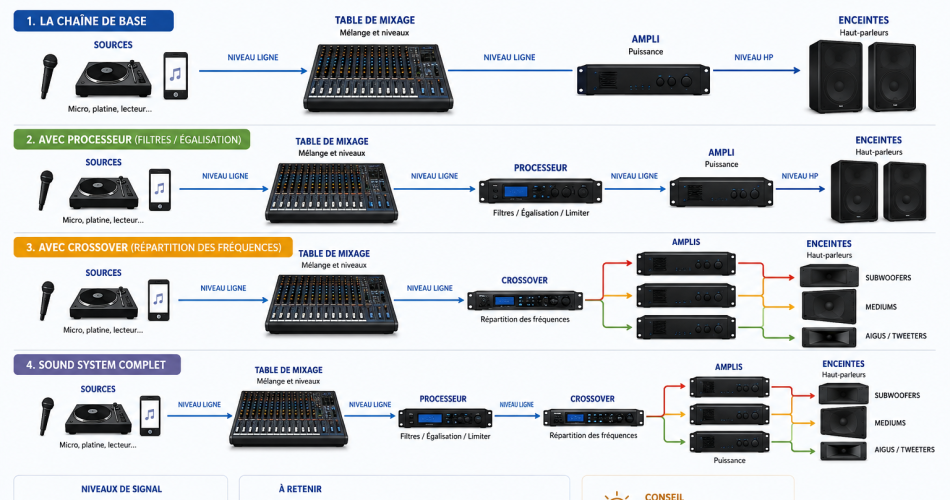
A mixer is always wired on the same logic: sources coming in, a mix in the middle, outputs going to the power. What changes from one rig to the next is what sits between the mixer and the speakers.
Here are the four diagrams that cover almost every case, from the simplest to a full sound system.
1. The basic chain

Three things to take away from this diagram:
- The level changes along the way. Between mixer and amp you are at line level. Between amp and speakers you are at speaker level. Different cables, different connectors.
- Never plug an amp into a phono input. A phono input is made for a turntable cartridge, a signal a thousand times weaker.
- Direction matters. An output always goes to an input. It sounds obvious, and it is still the most common mistake on mixers that use identical sockets for both.
2. Connecting the mixer to the amp

Which output to use
Take the master output, not a headphone output or a rec output. If your mixer offers both XLR and jack, prefer XLR: the link is balanced, so it survives long runs without picking up hum.
Which input on the amp
A line input. Most PA amps only have those, but some hi-fi amps also offer a phono input: never plug your mixer into it, you would overload the stage and risk the amp.
Switch-on order
Amps last, and off first. An amp left on while you plug or unplug sends the pop straight into the speakers.
Cables, amp modes (stereo, parallel, bridge) and gain setting are covered in detail in how to connect a mixer to an amplifier.
3. The sound system chain with preamp and active filter

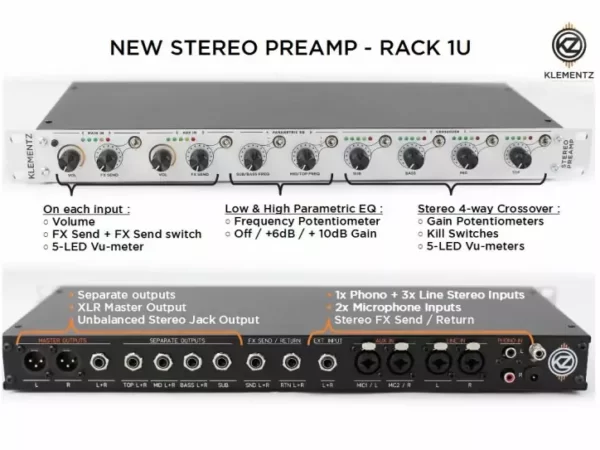
This is where a sound system parts ways with a normal PA. Instead of sending a full-range signal to one amp, you split the spectrum before amplification: the active filter in the preamp separates lows, mids and highs, and each band goes to its own amp and its own speakers.
Three practical consequences:
- You need one amp per way. A 3-way system means three amps, or three channels.
- Speakers only receive what they can reproduce. That is the first reason active filtering blows far fewer drivers.
- Phase becomes critical. Three bands arriving out of step cancel instead of adding.
Filtering is covered in detail in active and passive filters, and the list of preamp manufacturers is here.
4. Sends: effects and monitors

A mixer does not only blend and output: it can also send a measured copy of the signal somewhere else. That is the send, and it serves two purposes:
- An effect (delay, reverb, siren): the signal goes to the unit and comes back into the mixer. See how to plug an effect in a mixer.
- A monitor: the signal goes to an amp and a speaker placed near you. See how to connect a monitor.
The difference is one setting: an effect send is taken after the fader, a monitor send before it.
On an all-in-one machine, these sends are internal: the KLEMENTZ Dub Mixer, for example, routes its sources to its own delay and siren without a single cable, and keeps a send and return for plugging in an external effect.
The most common wiring mistakes
- Feeding a full-range input from a filter output. You will only hear part of the spectrum and spend a long time looking for why.
- Mixing balanced and unbalanced without knowing. It works, but you lose 6 dB and pick up noise over distance. Covered in balanced or unbalanced.
- Creating a ground loop. Two devices earthed through two different paths, and you get a 50 Hz hum.
- Using a passive Y to split an output. It loads the output and drops the level. Use a real separate output.
- Switching the amps on first. See above.
Thanks for reading, I hope this article was helpful!
🙏 If you enjoyed it, please share on your social networks 🙏
And if you have any remarks, thoughts, experiences or arguments to share:
Feel free to share in the comments below!