
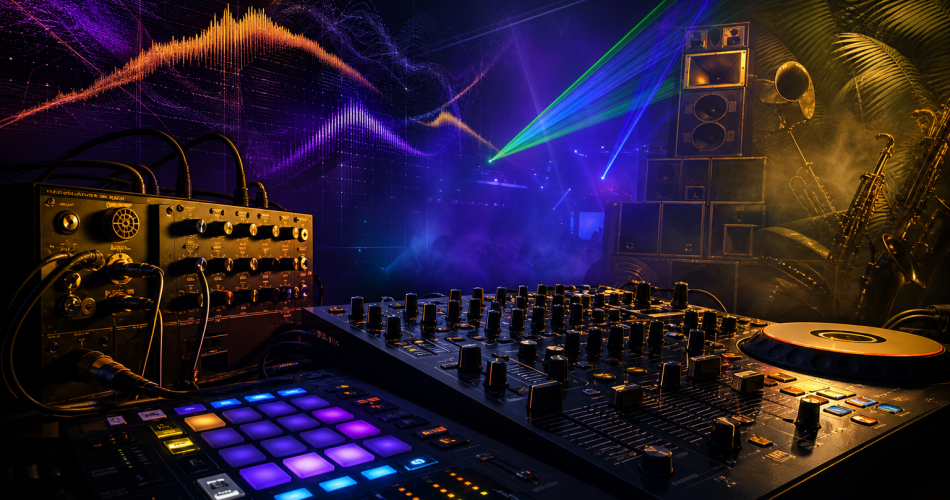
Dancehall, siren, laser DJ effects sampler: specialised packs in 2026
As well as generic impact and riser packs, certain musical genres require very specific effect sounds. Dancehall has nothing to do with techno, and samples that work in a sound system won’t work in an EDM main stage. This guide concentrates on three families of DJ effects that are in great demand and too often treated superficially: dancehall, sirens (in the broadest sense) and lasers.
Why specialised packs?
The all-purpose packs you find in the major libraries (see our general article on DJ samples) cover basic needs. But they quickly fall flat when you’re playing in a specific cultural context.
Play a dancehall set with generic EDM pack ‘yeah’s: it sounds wrong. Put a UK 90s rave siren over a tech-house drop: it’s misplaced. Put an 80s arcade laser in a deep house set: ridiculous.
Specialist packs solve this problem by offering authentic samples that are stylistically consistent with their genre.
Dancehall DJ effects: the Jamaican signature
What characterises dancehall samples
Dancehall has its own vocabulary of effects, inherited from Jamaican sound systems and Kingston dubplates:
- ShortMC cats (“pull up”, “selecter”, “big up”, “run dem”)
- Gun shots (samples of gunshots, cultural debates but omnipresent in the genre)
- Sirens and alarms specifically for dub/reggae – see our full guide to dub sirens
- Horn stabs (high-pitched reggae horns)
- Vocal phrases pitched (speeded-up or slowed-down vocals)
- Riddim drops (sub bass drops)
- Rewinds (tape samples rewound)
Where to find authentic dancehall samples
Dancehall producers and labels on Bandcamp
This is by far the best source. Many Jamaican, British and French producers specialising in dancehall publish their packs directly on Bandcamp, either for a fee or as a “name your price”. You’ll find original MC stabs, FX riddims tailored to the genre and direct support for the scene.
Look out for: “dancehall sample pack”, “riddim FX pack”, “reggae dub samples”.
Loopmasters / Splice Reggae & Dancehall categories
The big catalogues have dedicated sections. Loopmasters offers several Dancehall FX and Reggae Toolkits. Splice has a very extensive dancehall catalogue. Expect to pay €20-30 for a solid pack from Loopmasters, or use your Splice credits.
Sample free packs from UK producers
Some UK reggae/dancehall producers publish free packs on their websites or Soundcloud, in exchange for newsletter subscriptions. Search for “free dancehall sample pack 2026” or “free riddim FX pack”.
Sound system forums
For samples of real dub sirens, real MCs and real analogue horns, the forums and Facebook groups specialising in reggae/dub sound systems are a minefield. The exchanges between enthusiasts produce samples that are impossible to find elsewhere.
Tips for use in a set
- Rewind is the king of dancehall effects. Used to kick-start a riddim in spectacular fashion. But don’t overdo it: one rewind per 10 minutes is a maximum.
- MC chats on transitions: a pull up + small partial rewind, and you restart a drop. Very effective.
- Sirens between two riddims: the dub siren holds the sound bridge during the mix. See our ultimate guide to dub sirens.
- Avoid: stereotyped or caricatured dancehall samples, which can sound like clumsy appropriation if you’re not in a scene you know well. Go for the authentic.
Siren DJ effects: the whole world of sirens
“Siren” is a term that covers very different things depending on the genre.
The main families of sirens
Dub sirens (Jamaica, sound system)
The ancestor. Modulated electronic sounds (oscillator + LFO + delay) played on analogue hardware units such as NJD, Benidub, RDH. See the complete dub siren guide for culture, models and usage.
Rave sirens (UK, 90s)
The famous acid, hardcore and jungle rave sirens. More strident, more saturated, sometimes downright aggressive. Distinct from dub sirens in that they are more industrial in character and are used to build energy rather than punctuate it.
Trap / Hip-Hop sirens
Emerged in the 2010s with the rise of trap and drill. Often pure synthetics (Massive, Serum), with lots of pitch glide. Different from dub sirens in their digital timbre and very short duration (1-2 seconds max).
Police / emergency sirens
Samples of real police, fire and ambulance sirens. Used in hip-hop, drill and dancehall for urban storytelling. Use with discretion depending on the context.
Air raid sirens
Hyper-strident civil alarm sirens. Widely used in EDM main stage and dubstep for tense builds.
Where to find each type
| Type of siren | Best source |
|---|---|
| Dub siren | Bandcamp reggae producers, Loopmasters Reggae packs, hardware recordings |
| Rave siren UK | Loopmasters DnB/Hardcore packs, Industrial Strength freebies |
| Trap siren | Cymatics Trap packs, Splice Hip-Hop FX |
| Police/emergency | Freesound (often CC0), Soundsnap |
| Air raid | Cymatics, dubstep and EDM packs |
Test before you buy
Sirens are one of the most misclassified types of sample in shops. A ‘dub siren’ may in fact be a mislabelled rave siren. Always listen before buying or downloading.
Laser DJ effects: the big catalogue
Laser sounds cover a huge spectrum, from PEW PEW arcade to contemporary indus laser.
Laser sub-categories
Arcade / 8-bit lasers
Short synthetic sounds inspired by 80s video games (Space Invaders, Pong, Asteroids). Widely used in chiptune, glitch and ironic breakbeat. Often generated from emulated AY-3-8910 or SID modules.
Cinematic / sci-fi lasers
Long sounds with frequency sweeps, ideal for dramatic transitions. Star Wars-style, Tron-style. Many Hollywood sound design banks offer them.
Techno / minimal lasers
Very short, dry, little echo – work like tonal percussion rather than effects. Slip in between beats to add colour.
Dubstep / bass music lasers
A marriage between laser and bass: huge, processed, often with FM or grain. Used as both effect and sub-element.
Where to find them
In-house synthesis
It’s almost easier to generate them yourself in a synth than to look for them in a pack. A saw or a square with a pitch envelope that drops rapidly from 4 kHz to 100 Hz = basic laser. 5 minutes in Serum or Synth1 and you’ve got your own personal catalogue.
Paid packs
- Cymatics SciFi packs: excellent for kinematics
- 8DIO Steam Pipe Organ or sound design banks for cinema: high quality
- Sample Magic SciFi FX
Free packs
- Freesound (search for “laser”, “zap”, “sci-fi”)
- 99sounds regularly publishes free sound design packs
Usage advice
- One laser per transition maximum. Stacked up, it becomes ridiculous.
- Place the laser between two beats, never on beat 1. On beat 1, it crushes the track. On the off-beat, it enriches the track.
- Always EQ it: a raw laser often has too many strident highs. A low-pass filter at 8-10 kHz makes it bearable in the club.
Build a personal kit for your style
Here’s a simple framework for building a targeted library.
If you play dancehall / reggae
- 5-10 dub sirens (various: short, long, different tones)
- 10-15 MC stabs (pull up, selecter, big up, etc.)
- 5 horn stabs reggae
- 3-5 rewind samples
- 5-10 gun shot / FX impacts (depending on your ethical choices)
- 5 spring reverb hits
If you play DnB / Jungle
- 10-15 various rave sirens
- 5-10 MC stabs UK old school
- 5-10 amen breaks and rolls
- 10 woosh sweeps / risers
- 5-10 sub drops
If you play techno / house
- 5-10 risers white noise (4, 8, 16 bars)
- 5-10 deep impacts
- 3-5 minimal lasers
- 5 short vocal stabs
- 3-5 reverse cymbals
If you play bass music / dubstep
- 10-15 sub drops
- 5-10 large-calibre risers
- 10-15 lasers / cinematic FX
- 5-10 vocal stabs trap/grime
- 5 air raid sirens
Frequent mistakes
Buying a pack and never listening to it
Many DJs buy packs and never use the contents because they haven’t taken the time to tag the samples they like. Set aside one afternoon a month to explore a pack and tag 10 favourites max – the rest, forget about it.
The generic sample on a themed stage
A dancehall set featuring only samples from mainstream EDM packs will sound fake. Invest in stylistically coherent packs or record your own sounds.
Stealing samples
Avoid ripping samples from commercial tracks and playing them back in your set. It’s legally grey (even in mixes), and can cause problems if someone identifies the origin. Free or purchased samples solve the problem.
In a nutshell
Specialised DJ samples (dancehall, sirens, lasers) require a more detailed approach than generalist packs. Go for specialist producers on Bandcamp and community forums for dancehall, make a clear distinction between types of siren according to your genre, and synthesise your own lasers when you can – it’s quicker and more original. Limit yourself to a targeted kit of 30-50 mastered samples rather than a library of thousands.
To find out more:
- The complete guide to DJ effects to understand where to place each type
- The complete dub siren guide for reggae/dub signatures
- General DJ sample packs for the basics
Play your own siren instead of searching for a sample
Try siren sounds before choosing a pack with the blog’s online dub siren. You can adjust pitch, speed and echo directly in your browser.
Thanks for reading, I hope this article was helpful!
🙏 If you enjoyed it, please share on your social networks 🙏
And if you have any remarks, thoughts, experiences or arguments to share:
Feel free to share in the comments below!