
Everyone asks this question, and the honest answer starts with “it depends”. But it depends on specific things, and those can be priced. Here are real orders of magnitude, then what makes them move.
The short answer
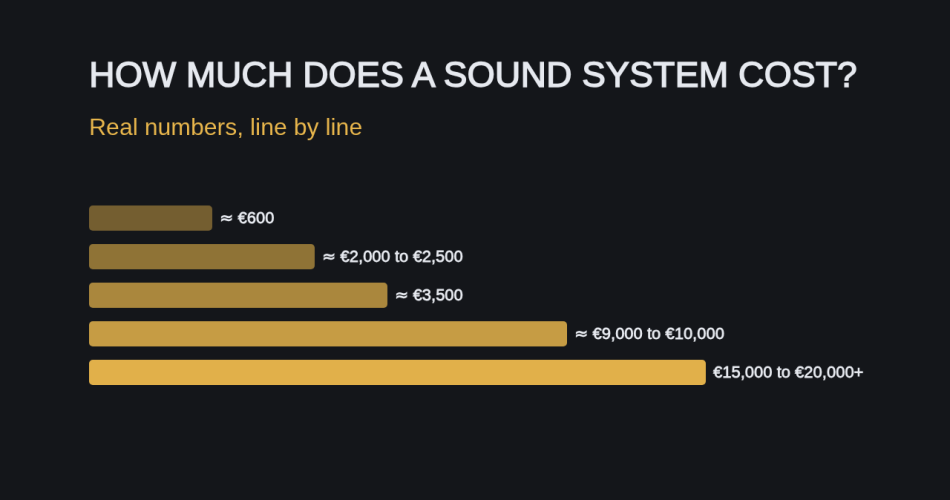
- About €600: a small second-hand set to learn the chain (mixer, processor, amp, two tops, one sub). Not a system ready for a party.
- About €2,000 to €2,500: a first build. Two home-made bass bins, second-hand tops, a processor, an amp, a measurement mic.
- About €3,500: the same, with a kick band added.
- About €9,000 to €10,000: a four-way project (sub, kick, mid, high), effects included.
- €15,000 to €20,000 and more: a full wooden reggae rig, the four-scoops-a-side kind. That is the range operators themselves give when you ask them.

And every year, even without buying anything: storage, transport, insurance, maintenance. Count over €1,000 for a small system that plays six dances a year.
Why the answers vary so much
Ask on a forum and you will get answers from €1,000 to €30,000. Nobody is lying. Four things move the price:
- New or second-hand. A second-hand branded box often costs less than the same one built yourself. A loaded second-hand scoop goes for around £500 to £800 in the UK; new and home-made, you pay for the wood, the driver, the hardware and the time.
- Build or buy. Building saves money, not time. And if you have the panels cut or the boxes assembled, labour counts.
- The finish. Painted boxes cost little. Veneered, varnished wood with bent-wood horns can cost more than the drivers. One operator quoted over $5,000 for the finish of a single rig.
- What you already own. A mixer, a computer, cables, a lock-up: something you already own is not paid twice. But it still counts in the value of the system.
Where the money goes
A real costing for a first build (about €2,150, prices checked in summer 2026):
| Item | Example | Amount |
|---|---|---|
| Sub drivers | 2 × branded 18″ | €550 |
| Sub wood | 2 sheets | €330 |
| Hardware and finish | 2 lots | €180 |
| Amp | 4 channels | €479 |
| Processing | 1 digital crossover | €199 |
| Tops | One second-hand pair | €150 |
| Cabling | Allowance | €150 |
| Measurement mic | USB | €110 |
| Total | €2,148 |

What stands out: drivers and amp are half of it. Wood, hardware and cables are almost the other half. And this table counts neither the mixer, nor transport, nor tuning the system.
A few reference prices that come up in every costing:
- Analogue dub preamp (the one that also splits the bands): about €1,300 to €2,000. A separate line, often forgotten when people compare it to the price of a digital processor.
- Connectors: an 8-pole Speakon around €15 each, 8-core cable around €10 a metre. A single 5 m cable for a tri-amped mid-top gets close to €90.
- Amps: from a few hundred euros second-hand to over €10,000 for a big touring amp.
The lines everyone forgets
On the forums, the most upvoted answer to “how much does it cost” is not about speakers. It is about storage and transport. A stack has to be stored, loaded, moved, and carried up stairs.
Add these lines to your spreadsheet before you set a budget:
- Storage: a dry, accessible space, all year round.
- Transport: van, fuel, dolly, straps, and the people to lift.
- Flight cases and protection for the amps, the preamp, the decks.
- Power distribution: it is sized for the venue and the loads, not guessed.
- Measurement: mic, stand, cables. Without measuring, you tune by ear, and ears are not enough.
- Insurance and maintenance.
- A reserve for the unexpected. Adding 20% to the basket is a good habit: €2,148 becomes about €2,580.
For a small system, a simple simulation already gives: storage €480 a year, transport €480 for six dances, insurance €200, maintenance €150. Over €1,300 a year before buying anything.
In what order to spend
The most expensive mistake is not paying too much. It is buying in the wrong order.
- Decide the architecture first: how many ways, which crossover points, which families of boxes. Everything else depends on it.
- Then choose the processing (digital processor or preamp) that matches. If the difference is not clear, read active and passive filters. Many people build their boxes first, then find out the fixed crossover points of their preamp do not suit them.
- Build one box, measure it, listen to it. Then build the rest.
- Put the money in the drivers rather than the cabinetry. A beautiful box with a mediocre driver stays mediocre. And “I’ll upgrade later” rarely happens.
- Start small and take it out. Half a stack that plays beats a full rig waiting in a garage. The rest will come with the dances.
To frame your project before the first purchase, take the quiz Before you buy your sound system.
What a dance costs
Once the system is paid for, every date has a cost. Take your yearly costs and divide them by the number of dances: €480 of storage is €80 per dance if you play six times, €160 if you only play three. It is not one more bill, it is what you need to put aside so the sound lasts.
Write down the crew’s time separately too: preparation, set-up, playing, packing down. Even unpaid, it is the first cost of a sound system.
Frequently asked questions
Can you build a sound system for €500?
To learn, yes, second-hand: a mixer, a processor, an amp and speakers you identify and check. To make a crowd dance, no: at that price, neither the output nor the protection is established.
How much does a reggae sound like the big UK sounds cost?
Operators themselves talk about €15,000 to €20,000 at least for a rig of four scoops a side in varnished wood, with preamp, amps and cables. Plus storage and transport.
Is it better to build or to buy second-hand?
Branded second-hand often works out cheaper. Building lets you choose exactly your boxes and drivers, and you learn. The right choice depends on your time, your workshop and your tools.
Rent or buy?
Compare like with like: equipment, transport, set-up, tuning. Don’t compare the hire price of one box with your full yearly costs.
Thanks for reading, I hope this article was helpful!
🙏 If you enjoyed it, please share on your social networks 🙏
And if you have any remarks, thoughts, experiences or arguments to share:
Feel free to share in the comments below!