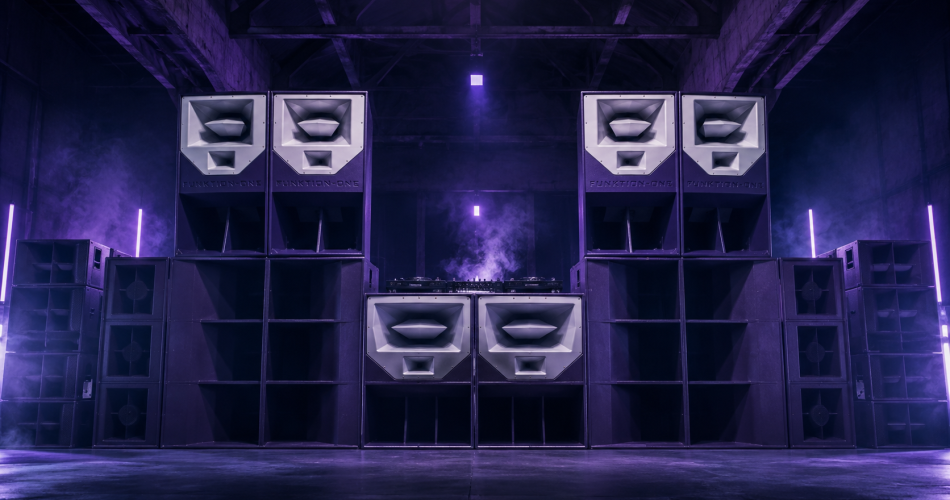
A techno sound system isn’t just a big PA set up in front of an audience. It’s a sound system designed to deliver acoustic pressure, a physical infra-bass and a clean kick, capable of penetrating the body without turning the mix into mush. Whereas a conventional sound system is mainly concerned with ‘making it loud’, a real techno wall of sound must combine three pillars: raw power, clarity of transients and spatial coverage.
In the world of clubs, festivals and free parties, brands such as Funktion-One, Lambda Labs, Void Acoustics and d&b audiotechnik have become benchmarks because they respond to the same obsession: making people feel the music as well as hear it. Funktion-One offers high-performance loudspeakers for a wide range of professional applications, Lambda Labs insists on high sound levels without compression, Void Acoustics combines technical innovation with distinctive design, while d&b audiotechnik offers a wide range of subwoofers for professional sound reinforcement.(Funktion-One)
The technology requires a system capable of holding pressure for hours. Not just 2 metres from the cabinets. Everywhere on the dancefloor.
What is a techno sound system?
A techno sound system is a complete sound diffusion system designed to reproduce electronic music at high volume, with particular attention paid to low frequencies, kick drum dynamics, signal processing and the distribution of sound in space.
Contrary to the classic image of the reggae or dub sound system, the techno sound system rarely uses an old-fashioned preamp. Instead, control is via a modern chain: DJ decks, mixers, DSP, amplifiers, subwoofers and tops.
But the objective remains very similar: to create a physical experience. A vibration. An impact. That sensation where the bass no longer just comes out of the speakers, but seems to occupy the air, the ground, the ribcage.
A good techno sound system must therefore meet three requirements:
- Go low: ideally with solid reproduction between 30 Hz and 100 Hz.
- Strike just right: the kick must be legible, fast and taut.
- Cover a wide area: the public must receive even pressure, without dead zones or aggressive excesses.
Techno sound system vs dub sound system: what are the differences?
A dub sound system is often referred to as a “sound system”, but the term is much broader. A sound system can play reggae, dub, bass music, trance, tekno, hard techno or industrial ambient. It’s not just the musical style that counts: it’s the philosophy of the system.
Dub and techno sound systems have a number of things in common: they play music at high volume, give bass pride of place and foster a collective, often underground, culture. In both cases, the sound is more than just an accompaniment. It’s the heart of the gathering.
The difference is mainly in the way it is used. Dub often relies on a culture of preamps, sirens, delays and live frequency cuts. Techno, on the other hand, generally requires a more direct response: a stable kick, controlled subs, great endurance, precise management of the crossover and limiters.
Simply put: dub breathes, cuts, revives. Techno pushes, hammers, hypnotises.
The components of a techno sound wall
A techno wall of sound is a complete chain. A weakness in one area can ruin the whole: poor cabling, an undersized amp, a badly adjusted crossover or misaligned subs can turn a powerful configuration into bass soup.
If you’re intereste in Dub / Reggae sound-system, we also have a dedicated article !
Subwoofers: the lungs of the rave
The subwoofers are the subwoofers. They produce the physical underpinning of the system: the rumble, the impact, the infra, the rush of air that gives techno its physical dimension.
When it comes to techno sound systems, there are three main types of cabinet.
Bass-reflex
Bass reflex is the most common type of subwoofer. It uses a port to reinforce certain low frequencies. It is relatively compact, versatile and effective at getting down low with a reasonable number of cabinets.
It’s often the simplest choice for a mobile system, a small club or a hybrid configuration. Its advantage is that it can offer good bass extension, particularly in the 30-50 Hz zone, which is important for deep electronic music.
Horn-loaded or pavilion
The horn cabinet uses an acoustic load that improves efficiency. In practice, it often makes it possible to obtain more acoustic pressure with less electrical power, especially when several cabinets are coupled together.
This architecture is very popular with large DIY systems, free parties and certain festivals. The sound is often described as more projected, more nervous, more “dry” in its impact. On the other hand, these cabinets are generally larger, more complex to build and less easy to operate on their own.
Manifold
The manifold brings together several loudspeakers in the same room or in a common architecture. The idea is to concentrate energy, increase impact and gain pressure in an optimised format.
This type of design can be very effective for large walls of sound, but requires real technical mastery. Poor filtering, poor alignment or the wrong choice of amplification: and the power quickly gets out of hand.
Top tips: surgical precision
Tops reproduce the mids and highs: synths, hats, claps, vocals, textures, sound effects, reverbs. In techno, they are just as important as subs, even if the public more often talk about bass.
A system with too much sub and weak tops will sound heavy, fuzzy and tiring. Conversely, aggressive tops can make the dancefloor unbearable after thirty minutes.
The key point is directivity. In a club, hangar or marquee, you need to avoid sending too much energy towards walls, ceilings and reflective surfaces. The more the venue reflects, the more crucial directivity becomes.
A good top must project precisely. It has to send the energy towards the audience, not towards the sheet metal of the hangar.
The DSP: the brain of the system
The DSP, or signal processor, is the element that controls the system. In particular, it manages :
- crossover, i.e. the separation between subs, low-mids, mids and highs;
- delays, to align the different speakers in time;
- levelling, to correct certain bumps or hollows;
- limiters, to protect the loudspeakers ;
- sometimes cardioid management of subs, to control rear diffusion.
On a techno sound system, DSP is not a luxury. It’s an insurance policy. Without it, you can have powerful subwoofers, solid amps and top-of-the-range tops: the result will still be approximate.
Amplifiers: the engine
Amplifiers supply electrical power to passive loudspeakers. In techno, they are required to last a long time, sometimes a whole night, with continuous and very demanding bass.
Modern class D amplifiers are widely used because they offer good efficiency, less heat build-up and significant power in a more compact format. Brands such as Powersoft have a strong presence in power PA racks.
The classic trap: choosing an amp solely on the basis of its advertised watts. You also need to look at low impedance stability, power supply quality, damping factor, ventilation and speaker compatibility.
For the Dub, see also our article on preamps
The flow signal from a techno sound system
[Platine DJ / CDJ / Contrôleur]
              ↓
          [Mixer DJ]
              ↓
      [DSP / Processeur]
      ↙        ↓        ↘
[Ampli Subs] [Ampli Mids] [Ampli Highs]
      ↓        ↓        ↓
[Subwoofers] [Tops / Médiums] [Tweeters / Aigus]
              ↓
          [Dancefloor]
Simple version :
Source → Mixing → Signal processing → Amplification → Broadcasting
Each stage must be clean. The wrong gain at the start can saturate the whole chain. The wrong DSP setting can cancel out the bass. Incorrect speaker placement can create an uneven dancefloor, with too much pressure in front and nothing at the back.
Legendary brands: 2026 comparison
There is no single “best” brand of techno sound system. The right choice depends on the venue, the budget, the musical style, the level of pressure required and the type of operation: fixed club, festival, free party, tour or DIY installation.
Fonction-One: organic clarity
Funktion-One is probably one of the brands most associated with club culture and electronic music. Its purple aesthetic has become almost mythical, but its reputation stems above all from its quest for clarity, dynamics and low aggression at high levels.
It’s a brand often chosen for clubs and festivals that want a powerful yet legible sound, with a real sense of presence. Tony Andrews, one of Funktion-One’s key figures, is regularly associated with this quest for a less compressed, more lively, more physical sound(Funktion-One).
Who’s it for? Demanding clubs, established collectives, festivals, venues that want a strong sound signature.
Strengths: clarity, musicality, sound image.
Weaknesses: high budget, demanding set-up.
Lambda Labs: power, precision, efficiency
Lambda Labs has established itself as a very serious brand in the electronic scene, particularly for powerful, precise and modern systems. The brand communicates a “loud without compression” approach, i.e. a high level of sound without the sensation of the signal being crushed.(Lambda Labs)
Their range of subwoofers is particularly interesting for configurations requiring impact, efficiency and a high level of bass response(Lambda Labs).
Who’s it for? Large collectives, outdoor events, techno, psytrance and bass music scenes.
Strengths: pressure, efficiency, modern precision.
Weakness: requires real expertise in setting up.
Void Acoustics: futuristic design, club impact
Void Acoustics is in a class of its own. The brand is instantly recognisable thanks to its sculptural, almost futuristic designs. But behind the aesthetics, there is a real system logic for clubs, events and immersive installations.
Void brings together technical innovation, strong aesthetics and an immersive sound experience(Void)
Who’s it for? Design clubs, hybrid venues, premium events, installations where visuals count as much as sound.
Strengths: visual identity, impact, immersive experience.
Weaknesses: budget and system consistency to be mastered.
d&b audiotechnik: control, reliability, coverage
d&b audiotechnik is a strong reference in professional sound reinforcement, particularly for installations, tours, theatres, clubs and large-scale events. Its strengths: control, range consistency, prediction tools and a highly systems-oriented approach.
The brand offers a wide range of subwoofers for mobile or installed applications, including cardioid designs in some ranges(d&b audiotechnik).
Who’s it for? Top-of-the-range clubs, service providers, festivals, professional facilities.
Strengths: control, reliability, predictability.
Weaknesses: less DIY culture, high cost.
Comparison table: which configuration for which use?
These budgets are orders of magnitude. They vary greatly depending on whether the equipment is new, second-hand, DIY, hire, acoustic treatment, cabling, transport and labour.
| Configuration | Typical use | Indicative budget | Indicative power | Area covered | Sound objective |
|---|---|---|---|---|---|
| Home studio / private mini-rave | Loud listening, production, small space | 1 500 à 5 000 € | 1 000 to 3 000 W RMS | 20 to 60 m² of floor space | Clean bass, physical but controlled listening |
| Small club / warehouse | 80 to 500 people | 8 000 à 35 000 € | 5,000 to 20k W RMS | 80 to 300 m² of floor space | Solid kick, even coverage, endurance |
| Festival / big wall of sound | 500 to several thousand people | 50 000 à 250 000 €+ | 30 kW RMS and more | 500 m² to several hectares | Pressure, range, control, safety, redundancy |
The wattage figure is never enough to judge a system. A well-designed 10,000 W system can sound louder, cleaner and more immersive than a stack of misaligned cabinets advertised at 30,000 W.
Configuring your system for technology: the golden rules
1. Align the phase before pushing the volume
Phase alignment is one of the most critical points. Two poorly aligned cabinets can partially cancel each other out. The result: you add equipment, you push the amps, but the bass disappears in certain places.
This is particularly noticeable around the cut-off frequency between subs and tops. If the kick loses its impact, the problem isn’t always the mix or the power. It often comes from poor time alignment.
To be checked:
- delay between subs and tops ;
- speaker polarity ;
- left/right coherence ;
- crossover frequency ;
- physical placement of the caissons.
2. Never make random adjustments
You can’t set up a techno sound system with a gruff ear while the dancefloor waits. The ear is indispensable, but it must be accompanied by tools: a microphone, FFT analyser, pink noise, SPL measurement, phase measurement.
The right method :
- measure the system at a reasonable volume;
- correct obvious problems ;
- settle deadlines ;
- stalling the crossover ;
- fitting limiters ;
- listen with reference tracks ;
- adjust slightly according to location.
3. Treating the place, not just the system
An empty hall, a tin shed, a vaulted cellar and a forest clearing do not react in the same way. The same sound system can be sublime in one venue and catastrophic in another.
In enclosed spaces, you need to keep an eye on :
- reflections on walls ;
- low-frequency resonance ;
- flutter echo ;
- glass or metal surfaces;
- the accumulation of bass in the corners.
Acoustic treatment can include basstraps, absorbent panels, diffusion or simply better placement of the system.
4. Protecting the ears without killing the energy
Techno is physical music, but you don’t have to pay for the pleasure with tinnitus. NIOSH recommends an exposure limit of 85 dBA averaged over 8 hours, and OSHA also states that exposure to noise above 85 dB can damage hearing.(CDC)
At events, therefore, you need to think about hearing protection, SPL measurement, breaks, the position of the audience and rest areas. You can’t tell a good system by how much it hurts. It can be recognised by its ability to remain loud, clear and bearable.
My opinion
“On an 8-hour techno set, the limiter shouldn’t be thought of as a brake, but as a safeguard. I always set the system with a safety margin: a threshold adapted to the speakers, a fast enough attack to protect dangerous transients, a sufficiently musical release to avoid pumping. If the limiter is working all the time, it’s not a good setting: it’s a sign that the system is under-dimensioned or that the gain staging is wrong”.
A good limiter protects the speakers, the amps and the audience. A bad limiter crushes the kick, fatigues the listener and makes the DJ want to push even harder.
Checklist: 5 things to check before turning on the sound
Before you throw the first kick, always check these five points.
1. Wiring
Are all the cables correctly connected, locked and identified?
A reversed, damaged or incorrectly connected cable can cause cuts, noise or power loss.
2. Phase and polarity
Do subs work together or against each other?
A polarity reversal can literally drain the dancefloor of its bass.
3. Gain levels
Is the chain clean from mixer to amps?
Avoid saturation at the DSP input or compensating for poor gain with the amps cranked up.
4. Amplifier ventilation
Do the racks breathe properly?
An amp that heats up in the early evening can become a serious problem at 5 o’clock in the morning.
5. Hearing protection
Have you planned for traffic jams, SPL measurement and rest areas?
A good sound system should make you want to stay in front, not run away after twenty minutes.
In this video, we see how a techno sound wall is assembled, wired, aligned and tested before opening to the public. The aim is not just to achieve a high volume, but clean coverage, a stable infra-bass and an even impact throughout the listening area.
Sound system culture: from DIY wall to free party
A techno sound system is more than just a data sheet. It’s also a culture.
At free parties, teknivals and raves, the wall of sound has long been a tool of autonomy. Setting up your system, transporting it, wiring it up, repairing it, upgrading it: it’s all part of the story. The sound system becomes a mobile manifesto. A way of creating a temporary, raw, collective space, far removed from the traditional circuits.
The legacy of groups like Spiral Tribe has helped to anchor this idea: music can exist outside the clubs, outside the official stages, with its own rules, its own places, its own power.
Today’s techno sound system culture navigates between two worlds. On the one hand, there are the DIY systems, sometimes hand-built from open source plans or salvaged cabinets. On the other, ultra-calibre professional installations equipped with advanced DSP, class-D amplification and acoustic prediction tools.
But at the heart of it all, the quest remains the same: to make a space vibrate, to bring bodies together, to create immersion.
Active or passive speakers for a techno sound system?
The question often comes up: should you choose active or passive speakers?
Active speakers
An active loudspeaker incorporates its own amplification and sometimes its own DSP. They are simpler to install, quicker to deploy and often practical for small configurations.
Advantages :
- quick installation ;
- fewer external racks ;
- integrated settings ;
- good choice for small events.
Limits :
- less flexible on large configurations ;
- sometimes more complex maintenance ;
- power supply to be managed on each enclosure.
Passive speakers
A passive loudspeaker requires external amplifiers. This is the most common logic used in large sound systems.
Advantages :
- great flexibility ;
- better centralisation of amplifiers ;
- more modular maintenance ;
- suitable for large sound walls.
Limits :
- requires more wiring ;
- requires suitable amplifiers;
- requires real mastery of routing and DSP.
For a small mobile techno system, active can be very relevant. For a powerful, upgradeable and repairable sound wall, passive is often more coherent.
What’s the budget for a techno sound system?
The budget depends enormously on ambition.
For a small private configuration with two tops and one or two subs, you’ll often need to spend several thousand euros. For a small club, the budget rises quickly with the DSP, amps, cabling, racks, measurement, acoustic treatment and installation. For a real festival system, we’re easily talking tens or even hundreds of thousands of euros.
The trap is to put everything in the cabinets and forget the rest. A coherent techno sound system also requires :
- a good mixer ;
- a reliable DSP ;
- suitable amplifiers ;
- serious wiring ;
- electrical protection ;
- flight cases ;
- measurement tools ;
- setting time.
Power can be bought. Coherence is built.
Conclusion: a good techno sound system doesn’t just make noise
A good techno sound system is not just judged by the size of the wall or the number of watts. It’s judged by what it provokes: a kick that slams without assaulting, an infra-bass that envelops without drooling, highs that remain precise, pressure that lasts all night without tiring the audience.
Techno is a music of sensation. It needs a system capable of conveying impact, repetition, tension and space. A real wall of sound doesn’t just have to be loud. It has to make the machine breathe.
And when all is well, something rare happens: the sound ceases to be in front of you. It becomes around you. Then inside you.
SEO FAQ
What’s the budget for a techno sound system?
For a small private setting, expect to pay between €1,500 and €5,000. For a small club or warehouse event, the budget can range from €8,000 to €35,000. For a complete festival system, it can exceed €50,000 and go much higher, depending on the brand, power, transport and installation.
What is the difference between dB and SPL?
The dB is a logarithmic unit of measurement. SPL, or Sound Pressure Level, refers to the sound pressure level measured in air. In sound reinforcement, dB SPL is often used to indicate the sound level perceived or measured at a given location.
Should you choose an active or passive sound system?
An active system is simpler to install and practical for small configurations. A passive system is more flexible, more scalable and often better suited to large techno sound walls. The choice depends on your budget, technical level and type of event.
How many subwoofers do you need for a techno party?
For a small private party, one or two good subs may be enough. For a small club, you’ll often need 2 to 6 subs, depending on the capacity and the venue. For a festival or large free party, the number can go much higher, with a real job of alignment and coverage.
Why does the bass disappear in certain places on the dancefloor?
This is often a problem of phase, placement or interference between several cabinets. Low frequencies create zones of reinforcement and cancellation. A good alignment of subs, delays and crossover reduces these problems.
What frequency is important for techno?
The techno relies heavily on the 30-100 Hz zone for the sub-bass and the body of the kick. The 100-250 Hz zone gives weight to the lower midrange. The legibility of the kick also depends on the transients in the midrange, not just the bass.
For more on the bottom end, read about reproducing frequencies below 40 Hz. To connect the equipment, the mixer wiring diagrams show the signal path.
Thanks for reading, I hope this article was helpful!
🙏 If you enjoyed it, please share on your social networks 🙏
And if you have any remarks, thoughts, experiences or arguments to share:
Feel free to share in the comments below!