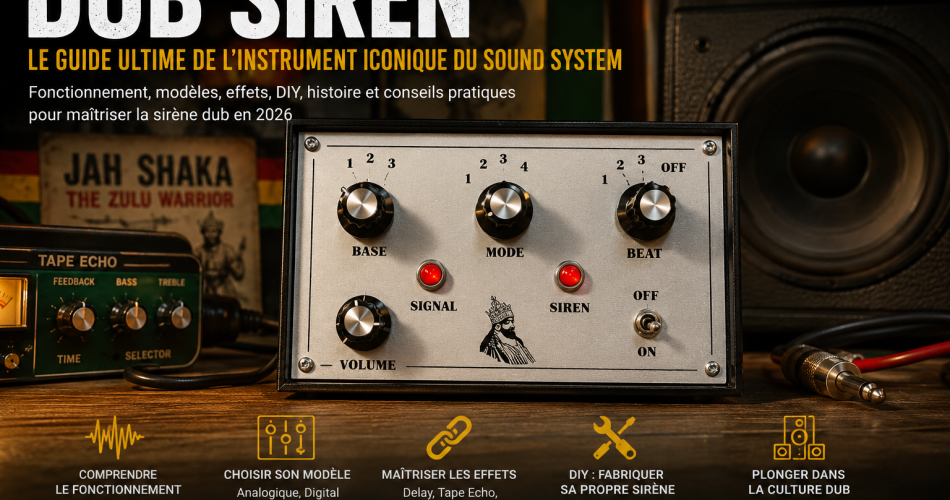
The dub siren is a small analogue or digital synthesiser designed to generate alarm, laser, airhorn and rhythmic oscillation sounds. In reggae/dub culture, it is used to energise a mix, announce a drop and create the tension typical of sound systems.
Key points to remember:
- How it works: a dub siren is often based on an oscillator modulated by an LFO.
- An essential effect: it really comes into its own with a tape delay, echo or spring reverb.
- Choice 2026: Benidub, Dub Research, NJD-style models, DIY and VST plugins cover almost all uses.
To wire this chain, see how to connect an effect to a mixer. For delay and reverb choices, explore the essential dub effects.
What is a dub siren?
A dub siren is a noise generator used in reggae, dub, steppers, jungle, sound system and sometimes live techno. Unlike a conventional synthesiser, it is not used to play complex melodies: it produces short, expressive and highly recognisable effects.
Its role is simple: to create impact.
A selector or sound system operator uses it to send a sound signal to the audience: a rise, a warning, a change of section, a boost of energy. A well-placed dub siren can transform a simple break into a moment of collective tension.
In the dub spirit, it’s not perfection that counts. It’s the gesture, the accident, the repetition, the analogue grain and the echo that degrades in the mix.
How does a dub siren work?
A dub siren generally consists of three elements: an oscillator, a modulation and a trigger.
The oscillator generates the basic sound. It can produce an aggressive square wave, a softer wave or a raw signal inspired by the old transistor circuits. On some DIY models, the heart of the circuit can be very simple, sometimes based on a 555-type timer or a transistorised oscillator.
Modulation gives movement. It’s often an LFO( Low Frequency Oscillator) that varies the pitch, speed or intensity of the sound. This is what makes it possible to obtain the famous ‘woo-woo’, laser, rising or unstable siren effects.
The trigger allows the siren to be played in real time. On many machines, the trigger button is momentary: the sound only comes out as long as the button is pressed. That’s what gives it that physical, almost percussive feel.
The most frequent checks
Pitch / Frequency
Adjusts the pitch of the sound. The higher the pitch, the more piercing the siren. The lower it is, the more massive and menacing it sounds.
Rate
Controls the speed of modulation. Slow creates a hypnotic oscillation. Fast, it produces a laser or machine-gun effect.
Depth / Modulation
This defines the amplitude of the movement. A light setting produces a subtle vibration; an extreme setting produces a wild, unstable siren.
Shape / Waveform
Changes the waveform or behaviour of the LFO: square, triangle, ramp, sine, or more experimental shapes depending on the model.
Trigger
This is the main play button. It can be used to send short siren blasts, hold a note or restart the echo in the delay.
Why is a dub siren almost never used on its own?
A ‘dry’ dub siren can sound flat, even too simple. The real dub sound comes when it passes through a chain of effects.
The classic chain is :
Dub Siren → Delay / Echo → Spring Reverb → Mixer / Preamp → Sound System
The delay repeats the signal and creates depth. The spring reverb adds a metallic, organic, almost physical texture. Together, they transform a simple analogue beep into a wall of echoes.
That’s why a dub siren shouldn’t be judged on its own. It needs to be tested in context: with a delay, a mixer, a riddim and a system capable of making the bass breathe.
Dub Siren + Delay + Spring Reverb: the ideal combination
To get an authentic dub sound, start with a simple chain:
1. Plug the dub siren into a delay pedal
An analogue delay or tape delay emulation works very well. Set the feedback to between 40% and 70% to create long repeats without losing control.
2. Adds a spring reverb after the delay
Spring reverb adds that lively, slightly unpredictable quality. The KNAS Ekdahl Moisturizer, for example, is a spring reverb with exposed springs that can be physically manipulated, perfectly illustrating this tactile approach to dub sound(knasmusic.com).
3. Send it all to a dedicated mixer track
Ideally, keep a separate channel for the siren. You’ll be able to mute the highs, push the echo, mute the signal or play with the live gain.
Recommended start setting :
| Element | Basic setting |
|---|---|
| Pitch | Medium to high |
| LFO Rate | Slow to medium |
| Delay Time | 300 to 600 ms |
| Feedback | 40 à 70 % |
| Reverb | Short to medium |
| Filter | Slightly reduced treble |
Analogue vs digital: which dub siren should you choose?
The choice depends mainly on your use: live sound system, studio, MAO production, DJ set or DIY.
Dub siren analogique: grain and gesture
An analogue siren is ideal if you want a raw, organic and unpredictable sound. The pots react directly under your fingers. Small variations in voltage, gain and filter give that ‘live’ feel that’s hard to reproduce perfectly.
It’s the best choice for sound systems, live dubs, selectors and producers who want a physical instrument.
Dub siren digitale: presets, stability and versatility
A digital siren often lets you save sounds, choose several LFO shapes, integrate a delay or go for more modern textures. It’s handy if you want a tool that’s flexible, compact and easy to recall in the studio.
The Dub Research Sound System Siren, for example, offers 5 types of LFO, 4 waveforms, a built-in PT2399 delay, preset saving and a micro-USB power supply.(Elevator Sound Europe)
VST plug-in: the practical choice for production
A plugin or emulation in Ableton, Logic, FL Studio or Bitwig lets you create dub siren-like effects without external hardware. You can use a simple synth, a square wave, a pitch-assigned LFO, then add a tape delay and a spring reverb.
It’s ideal for producing fast, automating effects and integrating the siren into an arrangement. On the other hand, the result will often be cleaner, less uneven and less tactile than with a dedicated machine.
2026 buyer’s guide: the best dub sirens
The prices below are actual prices as of 7 May 2026 and may vary according to distributors, taxes and availability. The Benidub DS71 is listed at £400 on the official website, with analogue voice circuitry and digital LFO; the Lickshot is listed at £185, with laser-gun, machine-gun and airhorn sounds; the Dub Research SSS1 is listed at £159 at Elevator Sound; Dub-Siren.com lists NJD-style models between £170 and £250(benidub.com).
| Model | Type | Price | Who is it for? | The little extra |
|---|---|---|---|---|
| Benidub DS71 | Hybrid: analogue voice + digital LFO | approx. €400 | Live dub, studio, serious sound system | Wide range of modulations and 8 LFO shapes |
| Klementz Lickshot | Analogue / sound FX | approx. € 185 | Beginners, jungle, reggae, fast effects | Very direct: pitch, LFO, trigger |
| Benidub DS01 | Classic analogue | approx. 215-230 € depending on retailer | Old-school sound, simple setup | Traditional dub siren spirit |
| Dub Research SSS1 | Digital with analogue elements | approx. £159 | Modern producers, compact live | Integrated delay and presets |
| NJD-style / Dub-Siren.com | Analogue or siren + delay combo | approx. £170 to £250 | Fans of UK roots sound | Simple, effective formula, sound system |
| DIY 555 / transistor | DIY analogue | variable | Makers, do-it-yourselfers, small budgets | Unique sound and total customisation |
| VST / Ableton rack plug-in | Software | free to paying | MAO, beatmakers, home studio | Automation and instant recall |
What’s the best dub siren to start with?
To start with, the best choice is a simple siren with few controls, a good trigger and an output that’s easy to plug into a delay. A simple dub siren is an excellent entry point if you want a simple physical machine. An Ableton rack or a free plugin may also suffice if you want to understand the principle first without buying any hardware.
Which dub siren should you choose for your sound system?
For sound system use, choose a robust machine with a good output level, accessible controls and a real presence in the mix. The Benidub DS71 is best suited to a wide sound palette. An NJD-style or DS01 will be more direct if you’re looking for a classic roots sound.
Which dub siren should you choose for your studio?
In the studio, go for flexibility. With a DS71, an SSS1 or a well-designed plug-in, you can record several takes, automate effects and build finer textures. The most important thing is processing: tape delay, reverb, filter and light saturation.
The story of the siren in dub culture
Dub siren comes from sound system culture, where sound is not just broadcast: it’s played, manipulated and pushed to its limits.
In the 1970s, figures like King Tubby transformed the mixing desk into an instrument. Dub was born of this way of removing voices, sending tracks into echoes, cutting frequencies and bringing sound space to life. Britannica highlights the importance of King Tubby and Lee Perry in the evolution of dub, particularly in the way they pushed studio equipment towards new rhythmic and structural forms.
Later, UK dub and roots culture reinforced this live dimension. Jah Shaka, a major figure on the British sound system, left his mark on the scene with his spiritual, massive sessions centred on the physical power of sound.
See also our article on The fascinating history of sound systems: How they changed music and party culture
The dub siren is part of this story: it’s not a gadget. It’s a signal. It announces, relaunches, warns, warms up the dance and engages in dialogue with the audience.
Build your own DIY dub siren
Making a DIY dub siren is one of the best ways to understand how it works. The circuit can be kept very simple: an oscillator, a few potentiometers, a trigger button and an audio output.
Basic components
| Component | Role |
|---|---|
| Timer 555 or transistor circuit | Signal generation |
| Pitch potentiometer | Height adjustment |
| Rate potentiometer | Modulation speed |
| Capacitors | Stability, timing, filtering |
| Resistors | Current and setting range control |
| Momentary button | Trigger |
| 6.35 mm or 3.5 mm jack | Audio output |
| Metal case | Protection and strength |
| 9V or 12V power supply | Circuit energy |
Why build a DIY siren?
A DIY siren won’t necessarily sound ‘better’ than a commercial model, but it will sound different. Each component, each tolerance, each solder joint can influence the behaviour of the circuit.
That’s precisely what makes DIY interesting: you’re not just making a tool, you’re making a sound personality.
Dub siren VST: can you get the same sound with a plugin?
Yes, you can create a convincing dub siren with a plugin, but it will feel different.
In Ableton Live, for example, you can start with a simple synth:
- Creates a MIDI track with a square-wave oscillator.
- Assigns an LFO to the pitch.
- Adds a low-pass filter.
- Places a delay after the synth.
- Finish with a spring reverb or convolution reverb.
- Automates delay feedback to create rise.
The result can be very effective in production. But live, a physical machine has one advantage: it can be played without looking at the screen. Mistakes, gestures made too quickly, knobs pushed too far are all part of the sound.
Common mistakes with a dub siren
Using the siren without delay
This is the most common mistake. A dry dub siren can sound weak. The delay gives it depth, repetition and energy.
Turning up the feedback
Too much feedback can quickly get out of hand. Live, start moderately and increase gradually.
Playing too often
The siren is powerful because it intervenes at the right moment. If it sounds all the time, it loses its impact.
Neglecting the gain
A siren can easily become aggressive at high frequencies. Adjust the gain, filter slightly and always test in the complete system.
Connection diagram
[DUB SIREN]
     ↓
[DELAY / ECHO]
     ↓
[SPRING REVERB]
     ↓
[MIXER / PREAMP]
     ↓
[SOUND SYSTEM]
Alt text image :
“Schematic diagram of how to connect a dub siren to a delay, spring reverb, mixer and sound system.”
FAQ – Dub Siren
What’s the best dub siren to start with?
The best dub siren for beginners is simple, robust and easy to plug into a delay. A Benidub Lickshot, a DS01 or a small NJD-style are good choices. If you want to get started with DAW, you can also use an Ableton plug-in or rack.
Can a dub siren be used on a smartphone?
Yes, there are mobile applications and solutions capable of generating dub siren sounds. It’s handy for testing out ideas, but less tactile than a real machine with pots, trigger and dedicated audio output.
Why does my dub siren make a clicking noise?
A click can be caused by the trigger button, a sudden change in amplitude, poor gain or a noisy power supply. In some cases, the click is part of the analogue character. If the noise is too loud, turn down the gain, check the cables and add a light fade or filter.
Do I absolutely need a delay with a dub siren?
Yes, in most cases. A dub siren can work on its own, but the delay is what creates the dub effect: repetition, space, tension and a rhythmic boost.
What’s the difference between a dub siren and a synthesiser?
A synthesiser is designed to play notes, bass, strings or melodies. A dub siren is more specialised: it produces short, expressive sound effects that can be manipulated live.
Thanks for reading, I hope this article was helpful!
🙏 If you enjoyed it, please share on your social networks 🙏
And if you have any remarks, thoughts, experiences or arguments to share:
Feel free to share in the comments below!