
Dub siren: the complete guide 2026
If you’ve ever heard that hypnotic siren hovering over a dub track, crashing in a cascade of echoes before melting into the bass, you’ve come across a dub siren. More than just a simple effect, it’s the sonic soul of a culture born in Jamaican sound systems and which today irrigates dub, steppa, dancehall and part of modern DJing.
This guide covers everything you need to know: where the dub siren comes from, how it really works, which models are essential and how to incorporate it into your setup, whether you’re a sound systemer, DJ or producer.
What is a dub siren?
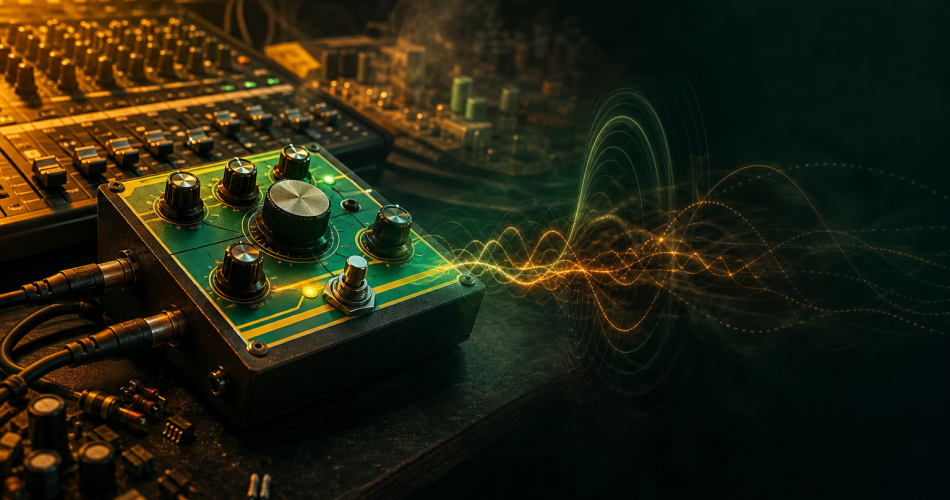
A dub siren is an electronic sound generator designed to produce the sirens, bleeps and sound effects characteristic of Jamaican dub. In practical terms, it’s a small box (or plug-in) containing one or more oscillators whose pitch can be modulated by an LFO, often combined with a delay or reverb to produce the bottomless echo typical of sound system sessions.
It differs from a traditional synthesiser in its specific purpose: it is not designed to play melodies, but to punctuate a mix with percussive sound incursions – siren wail, laser, bird call, UFO sweep – that interact with the music rather than accompanying it.
The origins: Jamaica, sound systems and the art of the selector
To understand dub siren, you have to go back to the Jamaican sound systems of the 60s and 70s. At the open-air dances in Kingston, operators like King Tubby, Lee “Scratch” Perry and Jah Shaka turned listening to music into a live performance. The selector didn’t just play records: he dub-mixed in real time – cutting the bass, triggering spring reverbs, throwing echoes onto the vocals, and roaring sirens to electrify the crowd.
The first sirens used came from hijacked civil alarm boxes, sometimes from cobbled-together Theremin modules or salvaged tone generators. It wasn’t long before local craftsmen and enthusiastic technicians began making dedicated units that were more stable, more modular and designed to integrate with sound system preamps. The modern dub siren is a direct descendant.
This lineage explains its design logic: robustness for the stage, tactile controls for the live mix, output compatible with sound system signal chains (often line level or compatible with a dedicated preamp).
How does a dub siren work?
Under the bonnet, the vast majority of analogue dub sirens are based on a simple, tried-and-tested schematic.
The main oscillator
At its heart is an audio oscillator that generates a wave (square, triangular or sawtooth, depending on the model). The most classic designs feature the legendary NE555 timer or its variants (LM555, TLC555), chosen for its stability, low cost and ease of implementation. This oscillator produces the base frequency – typically between 200 Hz and 4 kHz to cover the range of sirens.
The LFO (Low Frequency Oscillator)
Above this, a second very slow oscillator – the LFO – modulates the pitch of the first. It creates the movement of the siren: the slow pulse, the up-down sweep, the wobble. The rate controls the speed of modulation, the depth its amplitude. On advanced models, several LFO waveforms can be selected (triangle for a smooth sweep, square for a stutter effect).
Filter and shaping
Many dub sirens add a resonant low-pass filter to soften the harmonics of square waves and allow for more raucous or liquid sounds. Some, like the Benidub, also incorporate a VCA or envelope to shape attack and release.
Built-in effects
This is what distinguishes a dub siren from a simple oscillator. The best models come with :
- An analogue or digital delay (often 50-1000 ms)
- Adjustable feedback, sometimes including auto-oscillation
- Sometimes a simulated spring reverb or tape echo
Without effects, a dub siren is just a naked bzz. It’s the echo that transforms a siren blast into the atmospheric ripple that defines the genre.
Typical controls
On most hardware units you’ll find :
- Pitch / Tune: siren pitch
- Rate: LFO speed
- Depth / Mod: modulation depth
- Waveform select: choice of waveform
- Delay time / Feedback: echo parameters
- Volume / Output
- Trigger or Gate: momentary push-button to trigger the siren
Hardware or software?
This is the first practical question that arises. Both camps have their supporters.
Hardware offers the tactile experience, the warmth of analogue components, reliability on stage and – not least – the cultural aura that goes with it. You play an NJD or Benidub dub siren like you play an instrument. The touch of the momentary button, the feel of the pitch under your finger: it changes the performance.
The software (VST, plugins, mobile applications) is more flexible, more DAW-integrated and more affordable. For a home studio or a DJ controller setup, it’s often smarter. The best plugins faithfully reproduce the behaviour of an analogue, and some even do things that are impossible with hardware (preset recall, full MIDI automation).
Our advice: start with software to get the hang of it, then move on to hardware when you know exactly what you’re looking for.
The essential hardware models
Here are the references that keep cropping up in dub siren culture.
NJD (the legend)
NJD Electronics, based in the UK, is probably the most legendary name in the business. The NJD SE10 and its derivatives are analogue dub sirens with a sober, robust design and a sound character that is instantly recognisable. A firm favourite with purists, they can be found in countless European sound systems. Hard to find new, the second-hand market is active.
Benidub (Italian modernity)
Benidub, an Italian manufacturer specialising in reggae/dub sound system equipment, offers the DS01 and DS71 range. These units combine build quality, modern features (integrated delay, multiple voices) and commercial availability. They’re often the pragmatic choice for anyone who wants a new dub siren without going vintage.
RDH Electronics
RDH offers handcrafted dub sirens, sometimes in limited series, with a focus on sonic character and finishing details. Popular with demanding sound systems.
Klementz, Zongo, Mr Law, Supa Mana, Rigsmith
These names are often heard in sound system communities: they are craftsmen and manufacturers who produce small series, often to order. Each model has its own sound identity. They are an excellent compromise between the rarity of vintage NJD and the industrial availability of Benidub.
🔗 For a detailed comparison between the three major references, see our article: NJD vs Benidub vs RDH: which dub siren should you choose?
Software and app solutions
If you’re just starting out or if you work mainly in DAW, there are several options open to you:
- Dedicated VST/AU plugins: some specialist dub publishers offer very convincing emulations
- Modular software synthesizers (Reaktor, VCV Rack): allow you to recreate a 555 + LFO + delay schema.
- Mobile applications: handy for live performances or improvised jam sessions
- Sample packs: for those who just want the effect without building the sound
🔗 Our complete selection: The best dub siren VSTs and plugins
How do you integrate a dub siren into your setup?
In a sound system
The dub siren plugs into a preamp input channel (ideally a sound system preamp with EQ and send to the reverb spring). Many sound system operators route it via a dedicated channel so that it can be isolated in the mix and sent to the tape echo separately.
In DJ sets
Two approaches:
- Direct connection to an aux/return channel on the DJ mixer or a free channel
- Via a rotary mixer or a mixer with mic/aux input to take advantage of the EQ and effects sends.
On stage, keep it close at hand, placed on the side of the mixer or clipped to a stand.
In production
Insert it on an audio track in your DAW, either as hardware via an audio interface (with re-amping if you want to use an analogue preamp), or as a plug-in. Remember to automate the pitch and delay for lively transitions.
Do you have to build one yourself?
DIY has a real tradition in dub siren culture. Schematics are circulating, many are based on the NE555, and you can build a working unit for €30 to €60 worth of components. It’s a great introductory project to audio electronics, and you end up with a unique object that can be modified at will.
🔗 Follow our step-by-step tutorial: How to build a DIY dub siren.
If you want to understand the electronics before you put anything together, we’ve also broken down the NJD-type schematic and the role of the 555 timer.
How much does it cost?
| Option | Budget |
|---|---|
| Mobile app | 0 – 10 € |
| VST plugin | 0 – 100 € |
| DIY kit | 30 – 80 € |
| New Dub siren | 200 – 500 € |
| New Benidub | 250 – 600 € |
| NJD vintage used | 300 – 800 € |
| Top-of-the-range models / collectors | 800 € + |
For the second-hand market, see our buying guide.
FAQ
Is the dub siren just for reggae? No. Originally, yes, but it has spread widely to dubstep, drum and bass, jungle, dancehall and even experimental techno DJing. Any style that embraces sonic rupture can use it.
Do I need a specific preamp? Not necessarily. A dub siren is generally line-level and can be plugged into any mixer. However, a dedicated sound system preamp provides better tonal shaping and a rounder character.
Can a dub siren be played without an external delay? You can, but the effect will be much drier. Delay/echo is an integral part of the dub siren sound. Most modern units incorporate it; for the most minimalist, use a delay pedal or plugin.
What’s the difference between a dub siren and a toy stylophone/synth? A dub siren is designed for one-off live performance with a momentary trigger and a frequency range calibrated to break into a sound system mix. A stylophone is a melodic instrument, a toy synth is a general-purpose instrument. The uses don’t overlap.
Can a dub siren only be used in the studio? Absolutely. Many dub producers use it as a studio effects generator, without a live setup. In fact, it’s an excellent way of learning.
In a nutshell
The dub siren is not just a gadget: it’s a cultural instrument, a direct witness to the inventiveness of Jamaican sound systems, which continues to evolve between traditional craftsmanship and software innovation. Whether you want to play it in a sound system, integrate it into a DJ set or sample it in the studio, the choice of the right model depends on your use, your budget and the level of gesture you want to put into your mix.
Just starting out? Get started with a free plugin or app to get to grips with the language. Do you know where you’re going? Go for a new Benidub or hunt out a second-hand NJD. Are you a DIY enthusiast? DIY will help you understand the machine from the inside.
The rest is a matter of skill.
Thanks for reading, I hope this article was helpful!
🙏 If you enjoyed it, please share on your social networks 🙏
And if you have any remarks, thoughts, experiences or arguments to share:
Feel free to share in the comments below!